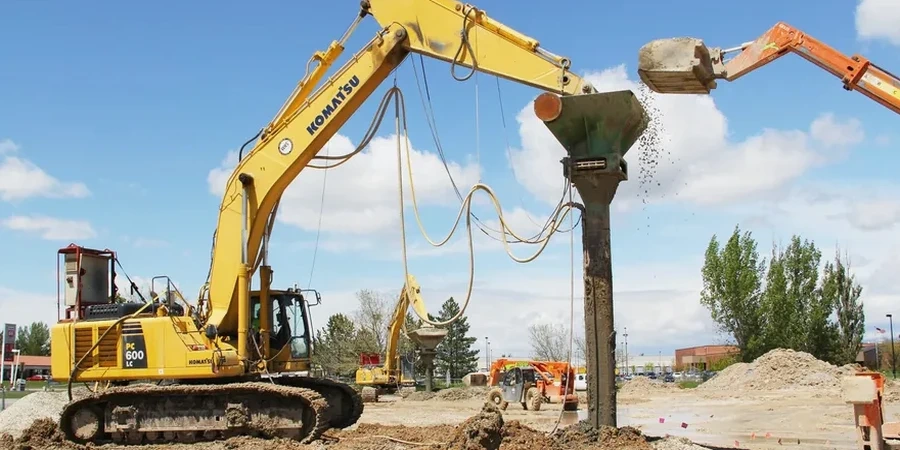
In Juneau, the legacy of glacial retreat and marine transgression has left a complex subsurface profile that often includes loose sands, silty outwash, and soft intertidal deposits. Many sites near the Gastineau Channel exhibit low relative density below 40 percent, which becomes a critical constraint when bearing capacity demands exceed 3,000 psf. Our approach to vibrocompaction design focuses on quantifying the energy input required to reach a target density, typically 70 percent relative density or higher under ASTM D4253, while accounting for the presence of fines that can dampen vibratory penetration. We routinely specify depth-vibrator configurations with working frequencies between 30 and 50 Hz, and when the fines content surpasses 15 percent, we evaluate the transition to alternative ground improvement such as stone columns to ensure drainage and lateral confinement. The design process relies on pre-treatment CPT soundings to map the compressible layers, followed by post-treatment verification using SPT or seismic cone tests to confirm that the improvement radius meets project specifications.
Effective vibrocompaction in Juneau demands a design that accounts for high groundwater, variable fines content, and seismic demands from the Queen Charlotte fault system.
How we work
Juneau's temperate rainforest climate delivers over 80 inches of annual precipitation, saturating the granular soils and raising the water table to within a few feet of the surface across much of the Mendenhall Valley. This near-surface saturation reduces effective stress and amplifies the risk of liquefaction during a seismic event, a concern underscored by the region's proximity to the Fairweather-Queen Charlotte transform fault. A properly engineered vibrocompaction program must therefore achieve densification below the phreatic surface, where backfill compaction is impractical. Our designs integrate real-time monitoring of vibrator amperage and penetration rate, correlating these parameters with cone tip resistance from pre-treatment CPT data. We establish performance criteria tied to IBC Section 1805 and ASCE 7-22 ground motion parameters specific to Site Class D and E profiles, which dominate the Juneau area. The specification package includes grid spacing, probe diameter, treatment depth, hold times, and water or air flush rates, all calibrated to the grain-size distribution obtained from split-spoon samples. For soils with more than 20 percent passing the No. 200 sieve, we incorporate pre-augering or jetting to facilitate vibrator advance, and we define acceptance testing protocols using SPT N-values or shear wave velocity measurements via downhole seismic.
Site-specific factors
The Juneau Seismic Zone presents a 10 percent probability of exceedance in 50 years for peak ground accelerations approaching 0.4g on soft soil sites, based on USGS hazard maps. Loose alluvial and estuarine deposits—common beneath the Mendenhall Valley, Lemon Creek, and Downtown waterfront—are susceptible to flow liquefaction if the cyclic stress ratio exceeds the soil's cyclic resistance ratio. A site that undergoes 4 to 6 inches of differential settlement due to seismic compaction can render a slab-on-grade or shallow footing system structurally compromised. Without a site-specific vibrocompaction design, the contractor may under-treat the critical depth or over-treat a zone that already meets density criteria, wasting budget and time. Our risk assessment couples CPT-based liquefaction triggering analysis with post-improvement settlement estimates, following the Seed-Idriss simplified procedure and refinements by Boulanger & Idriss. We also evaluate the potential for frost heave in the upper 3 to 5 feet, which can undo near-surface densification if drainage is not addressed. For waterfront projects subject to tidal fluctuation, we model pore pressure dissipation rates to ensure that the treated zone remains stable during construction.
Quick answers
What depth of loose soil can vibrocompaction treat in Juneau?
In the Mendenhall Valley and downtown Juneau areas, we typically design for treatment depths between 10 and 45 feet. The actual reachable depth depends on the vibrator's horsepower and the presence of dense interbeds that may require pre-augering.
How much does a vibrocompaction design package cost for a Juneau project?
Depending on site size, treatment depth, and the number of verification borings, a complete design package generally ranges from US$1,320 to US$5,300. A specific quote is provided after reviewing the geotechnical baseline report and site access conditions.
Can vibrocompaction be used if more than 20 percent of the soil passes the No. 200 sieve?
Effectiveness decreases significantly when fines content exceeds 20 percent, because silt and clay reduce permeability and dampen vibratory energy. In such cases, we evaluate whether stone columns or deep soil mixing would be more appropriate and include that recommendation in the design report.
What acceptance criteria do you specify for post-treatment verification?
We typically tie acceptance to a minimum relative density of 70 percent, a target SPT N-value, or a cone tip resistance threshold. The exact criteria are set based on the foundation loading and the seismic performance required under ASCE 7-22 for the specific Juneau site class.