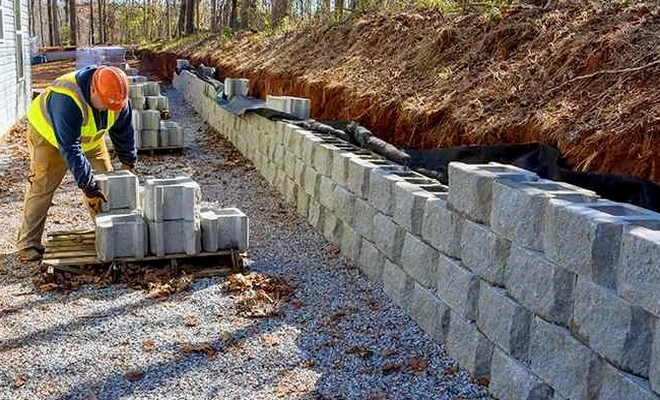
Juneau's geography doesn't leave much flat ground. Between the Gastineau Channel and the steep slopes of Mount Juneau and Mount Roberts, most buildable lots sit on some kind of incline. Combine that with 230-plus days of precipitation a year and you get a soil profile that's almost always near saturation. When a contractor or homeowner here starts excavating, they hit glacial till, marine clay lenses, or fractured bedrock faster than expected. A generic retaining wall design won't cut it. The lateral earth pressures behind a wall in Lemon Creek behave differently than those in Douglas, simply because the groundwater regime shifts block by block. We look at the actual boring logs, the weathered rock profile, and the seismic demand from the local IBC-adopted hazard maps before a single reinforcement bar gets detailed. When the slope angle exceeds 25 degrees, we also bring in a slope stability assessment to confirm that the proposed wall won't become part of a larger slide.
A retaining wall in Juneau isn't just holding back soil—it's managing water, accommodating freeze-thaw cycles, and resisting a seismic event all at once.
How we work
The soil contrast between downtown Juneau and the Mendenhall Valley is stark. Downtown, you're dealing with compact glacial till over bedrock at shallow depth—great for bearing, but tricky for drainage because water perches on that rock surface and builds up hydrostatic pressure fast. Out in the Valley, the soils are looser, with more organic silt and sand from the Mendenhall River's historic floodplain. Here, global stability governs more than bearing capacity. A wall that works downtown with a simple cantilever might need tieback anchors or a deeper key in the Valley to handle the softer foundation. We model both drained and undrained conditions because in a place where the average annual rainfall hits 90 inches in the city center, assuming drained behavior year-round is risky. The design has to work in May when the ground is thawing and in October when it's fully saturated. The IBC requires a minimum factor of safety of 1.5 for sliding and overturning, but in Juneau's colluvium slopes we often target higher margins, factoring in the long-term creep of these deposits.
Site-specific factors
Juneau's development history pushes residential construction onto slopes that were ignored fifty years ago. Roads like those in the Highlands or along Douglas Highway were cut into hillsides where the original soil profile is now exposed and slowly weathering. When a retaining wall fails here, it's rarely dramatic—it starts with a slow tilt, a crack in the facing, or water staining at the toe. But behind the wall, the soil mass is losing strength, and the next heavy rainstorm can accelerate the movement. The biggest threat we see in forensic reviews is inadequate subdrainage. A wall without a properly graded filter blanket behind it becomes a dam. In Juneau's climate, that's a matter of when, not if, the hydrostatic pressure will exceed the passive resistance. We design every wall with a drainage strategy that assumes the worst-case storm event from NOAA Atlas 14 data for the Juneau area. It's not just about meeting code minimums; it's about building something that still looks plumb after five winters of freeze-thaw cycling.
Relevant standards
IBC 2021 (International Building Code) Chapter 18 – Soils and Foundations, ASCE 7-22 – Minimum Design Loads and Associated Criteria for Buildings and Other Structures, ASTM D1586 – Standard Test Method for Standard Penetration Test (SPT) and Split-Barrel Sampling of Soils, ASTM D2487 – Standard Practice for Classification of Soils for Engineering Purposes (Unified Soil Classification System), AASHTO LRFD Bridge Design Specifications, Section 11 (where applicable for roadway walls)
Quick answers
What is the typical cost range for retaining wall design in Juneau?
For a standalone retaining wall design package—including geotechnical analysis of the retained soil, structural calculations, and stamped construction drawings—the fee typically falls between US$1,140 and US$3,960. The spread depends on the wall height, complexity of the site geometry, and whether additional subsurface exploration is needed. A simple 4-foot gravity wall on a single-family lot sits at the lower end; a 15-foot anchored wall with multiple tieback rows and a drainage plan reaches the upper end.
Do I need a building permit for a retaining wall in Juneau?
Yes. The City and Borough of Juneau requires a building permit for retaining walls that support more than 4 feet of unbalanced fill, or any wall supporting a surcharge like a driveway or structure. Our design package includes the structural calculations and details that the CBJ building official will review. We also coordinate with the CBJ's geotechnical review consultant when required.
How do you account for earthquakes in the wall design?
We use the ASCE 7 seismic coefficient for the site's specific latitude and longitude, not a blanket value for Alaska. The design includes a pseudo-static analysis where we apply a horizontal acceleration to the soil mass behind the wall, increasing the active thrust and reducing the passive resistance. For walls in the downtown Juneau area with shallow bedrock, the amplification is different than in the deep basin of the Mendenhall Valley, so we pull the site-specific spectral accelerations from the USGS hazard tool.
What information do you need from me to start the design?
We need a topographic survey of the site showing existing and proposed grades, the location of the wall, and any nearby structures or utilities. If you already have a geotechnical report with boring logs, that speeds things up considerably. If not, we can scope a targeted subsurface investigation—usually one or two borings at the wall alignment to get the strength parameters and groundwater depth.