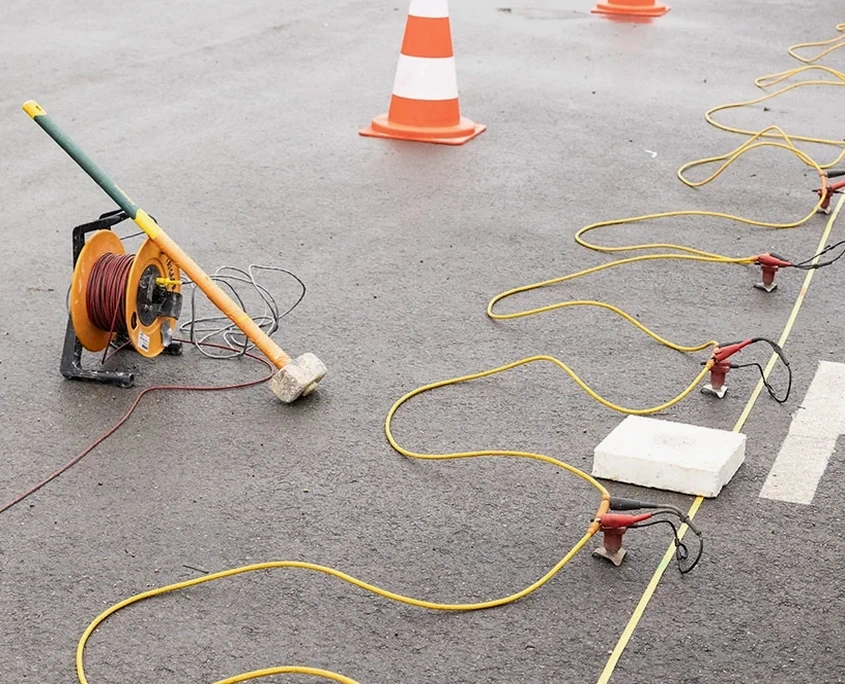
In Juneau, what you see on the surface rarely tells the whole story. The local terrain is a mosaic of glacial till, marine clay lenses, and fractured bedrock shaped by the Mendenhall and Lemon Creek glaciers. A standard boring program gives you data at a single point, but the material between those boreholes can shift dramatically over just a few meters. Seismic tomography bridges that gap by generating a continuous velocity profile of the subsurface, revealing hidden channels, weathered zones, and the true bedrock topography. When we run a seismic tomography survey in the Juneau area, we map the P-wave and S-wave velocities to help engineers plan excavations, locate competent bearing strata, and identify low-velocity zones that signal loose or saturated materials. For deep foundation design near Gastineau Channel, combining the tomographic grid with targeted CPT testing gives us a calibrated ground model that holds up under review. The steep valley walls and variable overburden depths common across Douglas Island and the Lena Point area make this imaging method particularly useful here.
A seismic velocity cross-section can reveal a buried channel or a dipping bedrock surface that a grid of boreholes might miss entirely in Juneau's glacial terrain.
Site-specific factors
The most common mistake we see on Juneau projects is a geotechnical investigation that relies solely on a sparse grid of test pits or borings without geophysical control. A contractor hits refusal on a boulder at 12 feet, logs it as bedrock, and the foundation design proceeds on that assumption. Later, excavation reveals a lens of soft silt beneath that boulder, with actual bedrock another 15 feet down. The change order and delay hit hard. Seismic tomography provides the lateral continuity to spot these inconsistencies. Another pitfall is ignoring low-velocity anomalies that indicate loose, water-charged material—punching a footing into that zone without ground improvement leads to differential settlement. On hillside lots in the Douglas area, undetected dipping bedrock surfaces can create a slip plane when combined with groundwater, and a retaining wall not keyed into competent material will rotate. The tomographic profile, interpreted alongside a solid liquefaction assessment when working in the alluvial flats, reduces these risks substantially.
Quick answers
What does a seismic tomography survey cost for a typical building site in Juneau?
For a standard building lot or small commercial site in the Juneau area, a seismic refraction tomography survey with a 24-channel array and one or two spread lines typically runs between US$3,050 and US$4,650. The final cost depends on the line length, the number of spreads, and how much brush clearing or helicopter access is needed on the steeper slopes around town.
How does seismic tomography compare to MASW for site classification per the IBC?
Seismic refraction tomography and MASW serve different parts of the site classification process. Seismic tomography gives a detailed P-wave velocity image that maps layer geometry and bedrock depth. MASW provides a direct S-wave velocity profile averaged over depth (Vs30), which is the parameter required by the IBC and ASCE 7 to assign a Site Class. On Juneau projects we often run both methods along the same line—refraction for the structural picture and MASW for the code-required shear wave velocity.
How far in advance should we schedule a seismic survey, and what site prep is needed?
During the May–October field season in Juneau, we typically schedule seismic surveys two to three weeks out. The crew needs a cleared survey line roughly 3 to 5 feet wide along the entire spread length; dense devil's club and alder should be cut back to ground level. We handle all permitting for work in the Mendenhall wetlands and coordination with CBJ right-of-way if the line crosses a public road shoulder. A site contact with a key for any locked gate speeds things up.