← Home · Laboratory

Triaxial Testing for Southeast Alaska Projects

Together, we solve the challenges of tomorrow.

LEARN MORE →

The soil conditions beneath Douglas Island differ substantially from those in the Lemon Creek valley. Glacial till dominates the benches while soft marine clays fill the lowlands near the Mendenhall wetlands. A standard penetration test provides N-values but cannot isolate the friction angle and cohesion parameters separately. This is where a triaxial test becomes essential for any foundation design requiring advanced constitutive modeling. The laboratory in Juneau runs both consolidated-drained and unconsolidated-undrained triaxial setups to match the drainage conditions expected during construction and throughout the structure's service life. For pavement design in the valley, we often pair the triaxial data with a CBR test to correlate stiffness with shear strength under repeated loading.

A single triaxial test on an undisturbed Shelby tube sample reveals more about Juneau's sensitive marine clays than a dozen SPT blows.
How we work

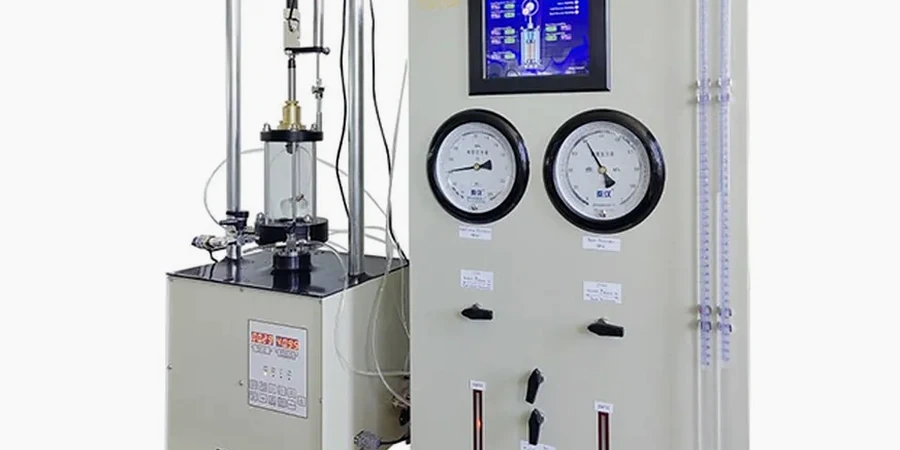
Juneau's hypermaritime climate, with over 230 days of measurable precipitation annually, keeps near-surface soils saturated for much of the year. This persistent moisture forces pore pressure conditions that can only be replicated properly in a triaxial cell with back-pressure saturation. Our setup follows ASTM D4767 for consolidated-undrained tests with pore pressure measurement, producing effective stress strength envelopes that account for the high groundwater table typical of Gastineau Channel shoreline projects. For coarse-grained materials from the borrow sources near Montana Creek, we run large-diameter specimens to minimize scale effects and combine the results with grain-size distribution curves to verify material compliance with state specifications. The stress path data feeds directly into the finite element models used by structural engineers designing deep excavations in the downtown corridor.
Triaxial Testing for Southeast Alaska Projects
Technical reference image — Juneau Alaska

Site-specific factors

The City and Borough of Juneau enforces the 2018 International Building Code with local amendments addressing snow loads and seismic criteria. Chapter 18 of the IBC requires a geotechnical investigation that includes shear strength determination for any foundation on sloping ground or within a mapped landslide hazard zone. Much of the developable land between downtown and Auke Bay sits on raised marine terraces underlain by sensitive glaciomarine clays that lose significant strength when remolded. A consolidated-undrained triaxial test with pore pressure measurement reveals whether the clay exhibits contractive behavior under shear, a precursor to flow failure. Skipping this test and relying solely on index properties leaves the design vulnerable to a slope instability mechanism that standard bearing capacity equations cannot predict.

Need a geotechnical assessment?

Reply within 24h.

Email: info@geotechnicalengineering.sbs

Technical data

ParameterTypical value
Specimen diameter1.4 to 4.0 in
Confining pressure range5 to 200 psi
Pore pressure transducer accuracy±0.1 psi
Axial strain rate0.001 to 0.05 in/min
Back-pressure saturation methodSkempton B-value > 0.95
Data acquisition interval0.1 s minimum
Drainage condition optionsCD, CU, UU

Associated technical services

01

Static Triaxial Shear Testing

Consolidated-drained, consolidated-undrained, and unconsolidated-undrained triaxial compression tests on undisturbed and remolded specimens. Effective stress parameters c' and φ' are derived from at least three confining stress levels per ASTM D4767.

02

Stress Path and Modulus Testing

Triaxial tests with small-strain instrumentation including local LVDTs or Hall effect transducers for measuring Young's modulus and Poisson's ratio at strain levels relevant to serviceability limit states.

Relevant standards

ASTM D4767 - Consolidated Undrained Triaxial Compression Test for Cohesive Soils, ASTM D2850 - Unconsolidated Undrained Triaxial Compression Test on Cohesive Soils, IBC 2018 Chapter 18 - Soils and Foundations, AASHTO T 297 - Unconsolidated Undrained Triaxial Test

Quick answers

What is the typical turnaround time for a triaxial test in Juneau?

A standard consolidated-undrained triaxial test with three confining pressures typically requires 10 to 14 calendar days from specimen extrusion to final report. The consolidation phase alone takes 24 to 48 hours depending on soil permeability. Projects with accelerated schedules can request priority processing.

How much does a triaxial test program cost?

A complete triaxial testing program with three confining pressures ranges from US$1,610 to US$2,870 depending on specimen preparation requirements and whether pore pressure measurement is included. Undisturbed samples that require careful trimming of sensitive clays fall at the upper end of the range.

Can triaxial tests be run on samples from remote Southeast Alaska sites?

Yes. We receive Shelby tube and thin-wall piston samples from sites across the Alexander Archipelago. The key requirement is maintaining the sample at in-situ moisture content and minimizing vibration during transport. Samples are stored in a humidity-controlled chamber upon arrival in Juneau until testing begins.

Location and service area

We serve projects in Juneau Alaska and surrounding areas.

View larger map