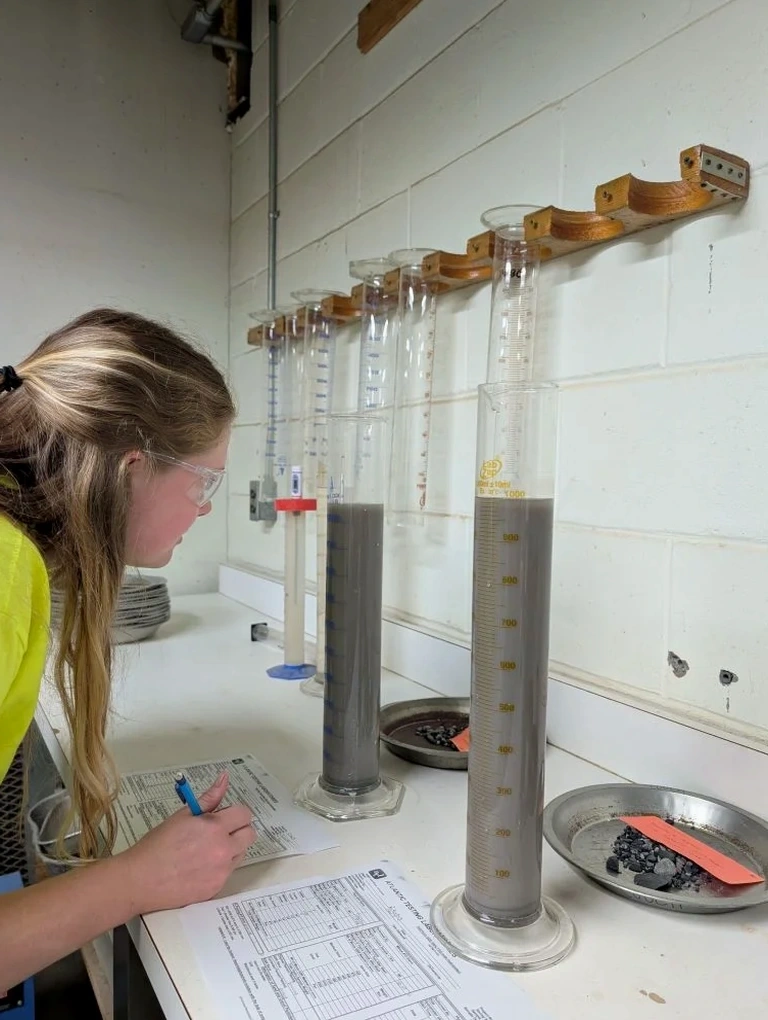
A common error we see in Southeast Alaska is importing granular borrow without verifying its soaked bearing strength, assuming a single CBR value fits all seasonal conditions. In Juneau, where precipitation exceeds 90 inches annually at the airport station, a subgrade that tests at 15% CBR in August can collapse to 3% or less by October once saturation reaches field capacity. Our laboratory CBR program eliminates that guesswork by compacting remolded specimens to target density and moisture—then submerging them for 96 hours under a 10-pound surcharge, per ASTM D1883 and AASHTO T 193. The resulting load-penetration curve defines whether the native Juneau glacial till or imported D-1 material will actually support a design ESAL loading of 50,000 or 500,000 without rutting, which becomes critical when the summer construction window closes and the pavement must endure freeze-thaw cycling and saturated base conditions for eight months straight.
A CBR value measured without a 96-hour soak is an August number; Juneau pavement design demands the November number.
Site-specific factors
Juneau sits at latitude 58.3° N in a coastal temperate rainforest, where the annual freeze-thaw cycle penetrates the upper 18 to 30 inches of pavement structure and groundwater recharge from the Mendenhall River basin keeps subgrade moisture near saturation from September through May. When a laboratory CBR is run on unsoaked specimens or on material dried back to a convenient moisture content, the resulting structural number overestimates the resilient modulus by a factor of two or more. That error propagates directly into the AASHTO 1993 pavement design equation, thinning the base course and asphalt layers below what is needed for a 20-year design life. We have measured soaked CBR values as low as 2.5% in the fine-grained marine sediments underlying the Mendenhall Valley, values that demand full-depth reclamation or lime stabilization before any asphalt placement. The Alaska DOT&PF Standard Specifications for Highway Construction reference CBR as a primary acceptance parameter for select borrow, and failing to meet the minimum 15% soaked CBR for base course material means the contractor shoulders the cost of replacement—a risk that a $150 laboratory test can eliminate before the first truckload arrives on site.
Relevant standards
ASTM D1883 – Standard Test Method for California Bearing Ratio (CBR) of Laboratory-Compacted Soils, AASHTO T 193 – The California Bearing Ratio, ASTM D698 / D1557 – Standard Test Methods for Laboratory Compaction Characteristics (Standard and Modified Proctor), Alaska DOT&PF Standard Specifications for Highway Construction (2024 edition, Section 203), AASHTO 1993 Guide for Design of Pavement Structures
Quick answers
What does a laboratory CBR test cost in Juneau?
A single-point soaked laboratory CBR test on a remolded specimen, including the companion Modified Proctor compaction curve, typically ranges from US$120 to US$190 depending on the number of points in the compactive effort series and whether swell monitoring is required. A three-point series to establish the full moisture-density-CBR relationship runs at the upper end of that range. We deliver a firm quote after reviewing the project specifications and the number of distinct material sources.
Why does Juneau require a 96-hour soak when other regions use shorter periods?
The 96-hour soaking period specified by ASTM D1883 and adopted by Alaska DOT&PF simulates the worst-case saturation that Juneau subgrades track record during the extended fall rainy season. With over 90 inches of annual precipitation and a shallow groundwater table in the Mendenhall Valley, drainage is slow and the pavement structure remains near field capacity for months. A shorter soak would underestimate swell potential and overpredict the design CBR, leading to under-designed base thickness.
How many specimens do you need to run a valid CBR program?
Alaska DOT&PF typically requires a minimum of three specimens compacted at different moisture contents bracketing optimum, each subjected to the full 96-hour soak and penetration test. This produces a moisture-versus-CBR curve that allows the designer to select the CBR corresponding to the expected field moisture range, not just a single point at optimum. For minor projects we can run a single-point verification, but the three-point series is the standard for any public right-of-way work in the Juneau area.
What is the difference between a field CBR and a laboratory CBR?
A field CBR test measures the in-place bearing capacity of a compacted layer using a portable apparatus driven at a controlled rate, without soaking or remolding. A laboratory CBR test remolds the material to a specified density and moisture, then submerges it for 96 hours to simulate long-term saturation. The laboratory value is almost always lower—and more conservative—because it accounts for moisture-induced softening. For pavement design in Juneau, we use the soaked laboratory CBR as the design input and the field CBR as a quality-control check during construction.
Can you test material that arrives frozen from a Juneau winter stockpile?
Yes, but it requires thawing under controlled laboratory conditions at room temperature without oven-drying, to preserve the natural moisture content. We then process the material through the No. 4 sieve and remold it at the target moisture within 24 hours of thawing. ASTM D1883 does not specifically address frozen samples, so we document the thawing procedure in the report and note any potential effect on the organic fraction, which is particularly relevant for Juneau muskeg soils that can lose structural integrity after a single freeze-thaw cycle.