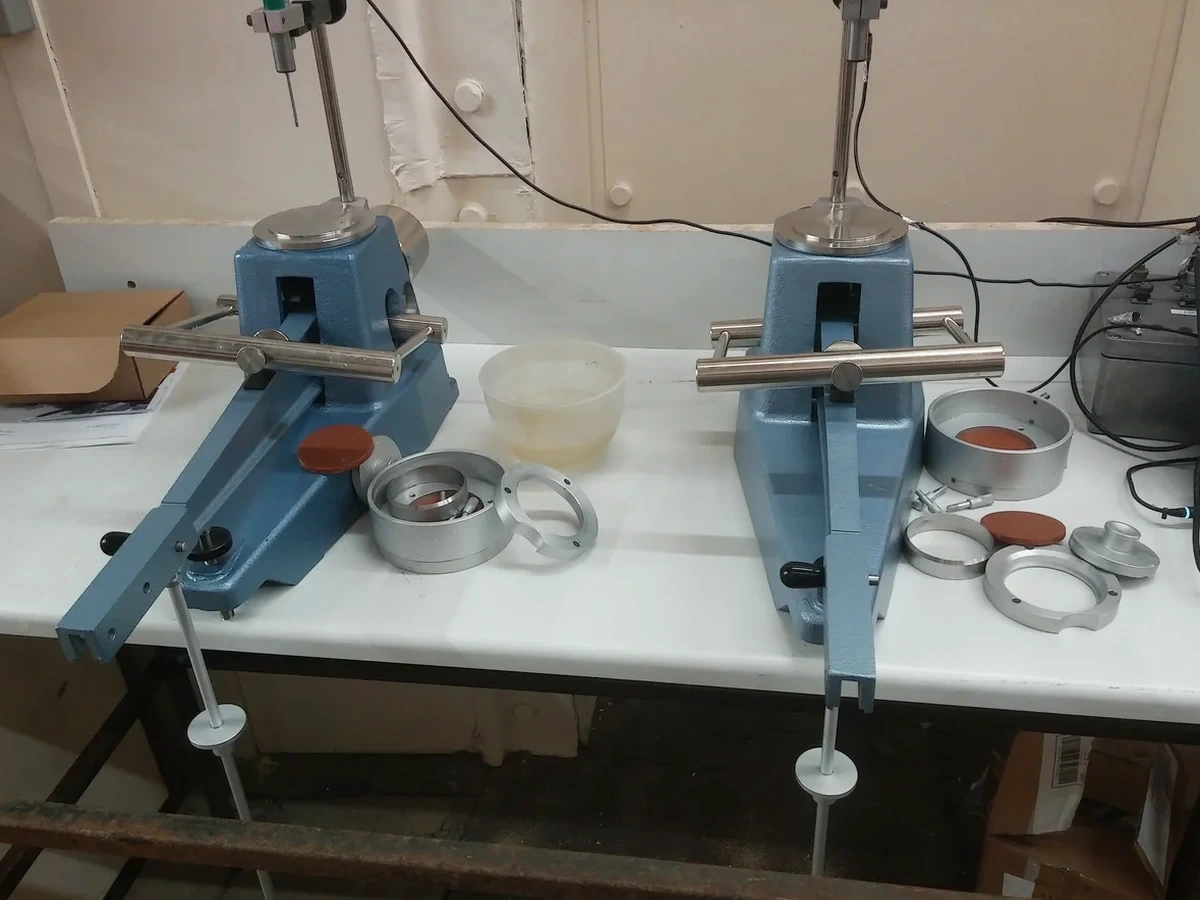
Juneau's soil profile is anything but simple. Glacial till, uplifted marine clays, and organic silts stack up in narrow valleys between the Coast Mountains and Gastineau Channel. When a foundation design misreads the plasticity of these layers, the consequences hit hard during freeze-thaw cycles. We run Atterberg limits per ASTM D4318 to quantify where a soil transitions from brittle to plastic behavior. For road subgrades on Douglas Island or building pads near Mendenhall Valley, knowing the liquid limit and plasticity index determines whether imported granular fill is necessary. The data feeds directly into Unified Soil Classification and helps structural engineers predict long-term settlement under saturated conditions. In a region where annual precipitation exceeds 50 inches and groundwater sits high in glacial outwash, getting these numbers wrong triggers costly excavation overruns and premature pavement failure.
Juneau's glacial silts can hold a liquid limit above 60% and collapse structurally after a single heavy rain—plasticity data is what prevents a foundation from failing.
Relevant standards
ASTM D4318 – Standard Test Methods for Liquid Limit, Plastic Limit, and Plasticity Index of Soils, ASTM D2487 – Standard Practice for Classification of Soils for Engineering Purposes (Unified Soil Classification System), ASTM D4220 – Standard Practices for Preserving and Transporting Soil Samples, ASCE 7 – Minimum Design Loads and Associated Criteria (soil parameter input for foundations), IBC Chapter 18 – Soils and Foundations (classification and bearing capacity correlation)
Quick answers
What is included in an Atterberg limits test report?
The report provides liquid limit, plastic limit, and plasticity index per ASTM D4318, along with the Unified Soil Classification per ASTM D2487. If natural moisture content is supplied, we calculate the liquidity index. Each report includes sample identification, preparation method, and the number of blows versus moisture content curve for the liquid limit determination.
How much does Atterberg limits testing cost in Juneau?
Standard Atterberg limits testing runs between US$60 and US$90 per sample depending on whether a shrinkage limit or liquidity index calculation is added. Expedited turnaround carries a modest surcharge. For multi-sample project pricing, we deliver a consolidated quote after reviewing the boring log or sampling plan.
How long does it take to get results?
Standard turnaround is three business days from sample receipt. Expedited service delivers results in 24 hours when the sample arrives before 10 a.m. Larger projects with more than 20 samples are scheduled in advance to maintain consistent processing times.
When do I need Atterberg limits versus a simple grain size analysis?
Grain size tells you the distribution of sand, silt, and gravel, but it doesn't capture how fine-grained soils behave when wet. If your Juneau site has silts or clays, Atterberg limits reveal the plasticity that controls shrink-swell potential, frost susceptibility, and shear strength. For cohesive soils, both tests are often run together to produce a complete USCS classification.
Does the lab accept samples from remote Southeast Alaska sites outside Juneau?
Yes. We receive samples from Haines, Skagway, Sitka, and other communities in the region. The key requirement is that samples arrive properly sealed and labeled with chain-of-custody documentation. For projects requiring quick turnaround from remote locations, we coordinate with air freight carriers serving Juneau International Airport.