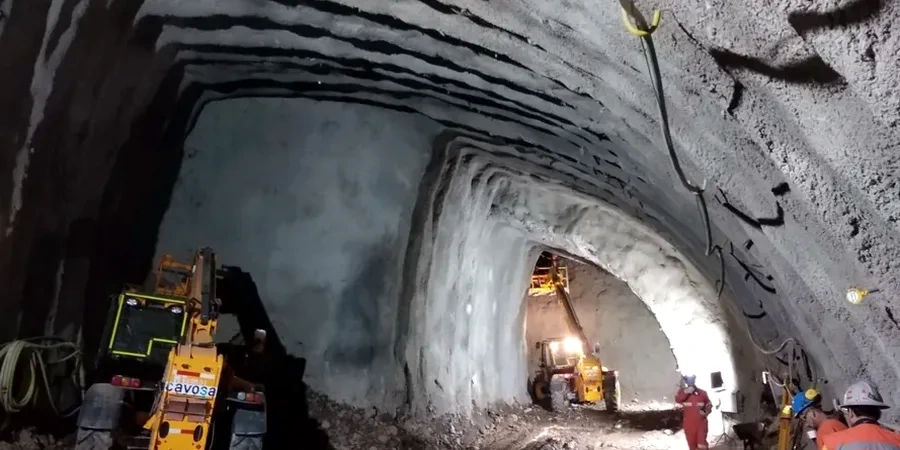
Tunneling through the saturated glacial and marine deposits of Southeast Alaska demands a solid geotechnical framework that goes well beyond standard site investigation. In Juneau, where the terrain rises sharply from the Gastineau Channel and much of the flat buildable land consists of compressible estuarine silts and clays, the interplay between soft ground behavior and structural design is critical. The analysis is anchored in ASCE 7 and IBC requirements, supplemented by site-specific laboratory programs following ASTM D2487 for soil classification and advanced strength testing. For tunnel projects near the Mendenhall Valley or under downtown Juneau, characterizing the undrained shear strength and consolidation properties of these sensitive soils is not a formality—it defines the excavation method, face support pressure, and long-term lining performance. A comprehensive in-situ permeability assessment often becomes the deciding factor for groundwater control strategies, as perched aquifers and tidally influenced pore pressures are common across the Juneau area.
In Juneau's glaciomarine clays, face stability is governed by undrained shear strength and the rate of pore pressure dissipation ahead of the tunnel heading.
How we work
Juneau's urban footprint expanded during the mining booms of the late 19th and early 20th centuries, often on reclaimed tidelands and valley fill that now underlie critical infrastructure. This legacy means that many soft ground tunnel alignments in Juneau encounter a challenging sequence: anthropogenic fill over highly plastic glaciomarine clay, transitioning into dense glacial till or bedrock. The historical lack of deep foundations in early construction means that modern tunnel boring machines (TBMs) or sequential excavation methods (SEM) must pass beneath aging structures with minimal settlement tolerance. A detailed geotechnical analysis for soft ground conditions in Juneau quantifies the consolidation settlement potential, lateral squeeze risk, and face stability parameters. Undisturbed sampling and oedometer tests reveal whether the clay is normally consolidated or overconsolidated—a distinction that changes the predicted surface settlement trough by a factor of two or more. The engineering team correlates downhole geophysical logs with laboratory Atterberg limits and triaxial shear data to build a continuous ground model, ensuring that boulders or abrupt transitions into weathered bedrock do not surprise the contractor during excavation beneath Juneau's sensitive downtown corridor.
Quick answers
What makes soft ground tunneling in Juneau different from other locations?
Juneau's geology is dominated by glaciomarine and estuarine deposits with high sensitivity and low permeability. The proximity to the Gastineau Channel introduces tidal pore pressure fluctuations, and the steep valley walls create complex groundwater regimes. These conditions demand a site-specific approach rather than applying generic soft ground parameters.
What is the typical cost range for a geotechnical analysis for a soft ground tunnel in Juneau?
Depending on the length of the alignment, depth of investigation, and required laboratory testing program, a comprehensive geotechnical analysis for soft ground tunneling in Juneau typically ranges from US$3,710 to US$15,220. Shallow utility tunnels fall at the lower end, while deep sewer or transportation tunnels with extensive triaxial and consolidation testing approach the upper range.
Which laboratory tests are essential for characterizing Juneau's soft ground?
Consolidated undrained triaxial tests with pore pressure measurement, incremental oedometer consolidation tests, Atterberg limits, and grain size distribution per ASTM D2487 form the core program. For sensitive clays, we also recommend fall cone tests and remolded shear strength comparisons to quantify sensitivity.
How long does a typical soft ground tunnel investigation take in Juneau?
A field investigation program with drilling, sampling, and piezometer installation typically spans three to six weeks, depending on access constraints and the number of boreholes. Laboratory testing and reporting add another six to eight weeks. Projects requiring winter drilling in Juneau may face additional logistical delays due to snow load and limited daylight hours.